ANYONE ELSE BUT ME
Joel Haver's Shakespearean crime drama reaches mythic heights.

One of the aspects that makes myth so powerful is the concept of the archetype or role. The characters in a mythic drama are not just characters, who may or may not reflect “real” or historical personages, but they also embody something deeper. This is one of the many ways myths reflect our lives. We are all actors playing the role of hero or villain, monster or sage, seducer or confidant, in any given scenario. Our identities are not fixed but Protean and shifting constantly.
Joel Haver intuitively understands this as a filmmaker. It is why his worlds feel so real and lived. Far from being meta purely for the sake of pretension, Haver’s stories are set in the desperate, desperate world of failed films and failed actors in order to explore how our identity is mythically warped by circumstance and the “performance” of being alive. As Shakespeare observed,
“The play's the thing, wherein I'll catch the conscience of the king.” —Hamlet
The world of theatre and film is not illusion, but a mirror in which our own world is reflected, and in a strange way, the reflection shows the truth of the human condition more accurately than the “real” world can. We see ourselves in the archetypes that dance on the screen and recognise some deeper truth than what lies on the surface of our perception.

This is especially true of Haver’s 2024 thriller masterpiece Anyone Else But Me. With his love of fantasy RPGs, stop-motion, animation, and comedy, I never expected Haver to write and direct a thriller movie, but Anyone Else But Me is an exemplar of the genre that simultaneously fulfills and subverts expectations. It is funny, genuinely tense (even frightening at several points), and totally immersive. The film drags us into a world of young people who have been denied a future, desperately trying to make it by doing anything necessary and, more to the point, being anyone necessary.
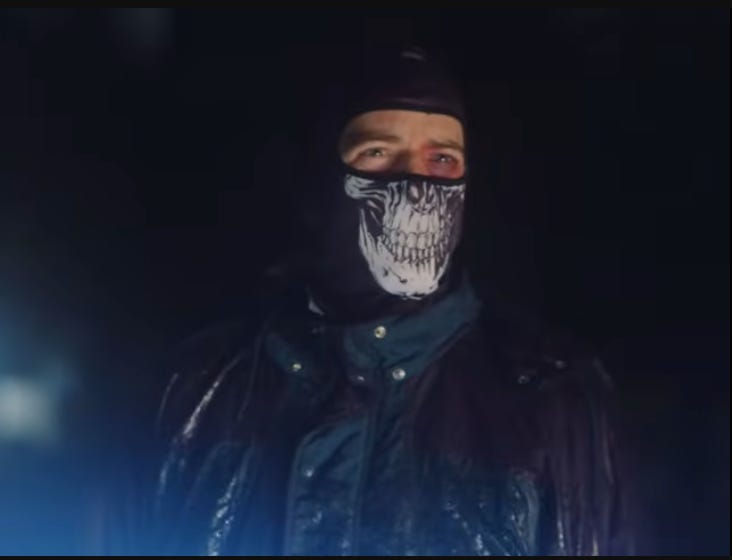
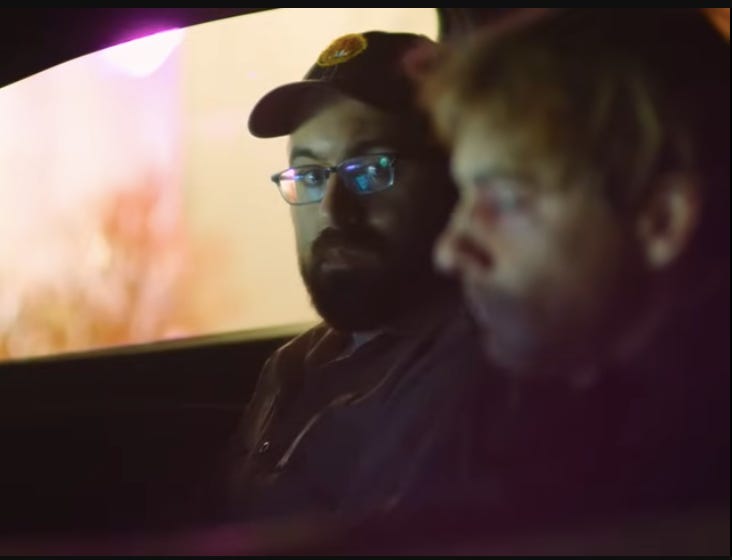
At the risk of giving a spoiler for the movie, there is one scene that illustrates all of the above perfectly. Failed actor Darren (played with heroic sincerity by Blake Rosier) has caused—through his disregard for other people’s feelings—a woman to be kidnapped. Believing he is a multi-millionaire, the kidnappers demand a ransom of two-million dollars. In a Shakespearean turn, Darren recruits another more successful actor, Josiah (played by Jim Belden), to pretend to be him. Josiah is sent to meet the kidnappers to negotiate, believing this is some kind of immersive performance-art piece with Darren directing. This may sound far-fetched, but because of the way the story unfolds, and how the sheer desperation of pretty much everyone in showbiz is underscored, we are left in no doubt that these people would do this.
So, Josiah confronts the kidnapper, and talks tough, not realising he is speaking to a real, dangerous criminal. Meanwhile Darren watches horrified as Josiah throws away the pre-prepared script of what he is supposed to say and gets far, far too into it. The whole thing is hysterically funny yet at the same time fraught with tension and the potential for real violence; I was in tears of laughter and gripping the edge of my seat at the same time. When Josiah finally gets back into the car to debrief with Darren, he says, “Who is that new guy?” (Meaning the kidnapper.) “He is a great actor.”
Comedy gold. But it is also more: an exposé of the human condition. Josiah successfully negotiates his way out of a dangerous situation purely because he believes it all to be theatre, because he is pretending to be someone else. In this way, Haver shows how our own limiting beliefs about ourselves and our lives are what create our suffering; we could be anyone, if we wanted to be. Yet we choose to be losers and cowards and failures. But the flip side of this is that the allure of escapism into another “self” also has pitfalls and dangers. We can become overly intoxicated with these false selves and their narratives, losing our grounding, and unleashing destructive forces as a result. The film offers no easy solutions to this conundrum, and it is in this liminality and ambiguity that Haver creates real art.
There is an added level of comedy to the above scene in that the kidnapper—whose real name we never discover—is played by none other than Cherdleys. I’ve always felt Cherdleys was a better actor than he’s been given credit for, but in this film he shows he is not only a brilliant actor but the kind of actor who makes a movie. This is not to discredit anyone else because frankly every performance in this film is gold-dust, and you can tell how hard everyone worked, how deeply they committed to their roles at every stage of the film’s journey. I’m honestly blown away by the talent on display. Haver, of course, is also to be commended for assembling such a great team and eliciting such amazing performances from them.
But Cherdleys is special, here. He commands the screen in a totally unique way. It is star-power and then some. Which is why Josiah’s line about the “new guy” being “a great actor” works on so many levels.
Anyone Else But Me is a meditation on identity. Haver recognises the absurdity of the masks we wear, but also the tragedy too. One man’s tragedy is another’s comedy, after all, a fact that is beautifully illustrated by an incredible bit of acting from Italia Ponticorvo, when, in spite of her dire situation, she begins to laugh uncontrollably at her captors. Indeed, the film oscillates between tragedy and comedy with an effortlessness only the very greatest storytellers can achieve.
Having already spoiled one scene, I won’t spoil any more. There is so much to discover. The film is only 93 minutes long, yet it is a bounty, a rich feast of ideas presented with Haver’s trademark clarity and confidence. Haver frames shots like they are paintings, and then allows the canvases to breathe with performances that feel lived. Like Hello My Beautiful Creatures, Anyone Else But Me proves that Haver is in a class of his own as a filmmaker. For those fearing the decline of Hollywood movies, may I introduce you to a better class of criminal.
Great news! If you want to watch this movie, Joel Haver uploads all of his films—even his full length features—on YouTube for FREE.